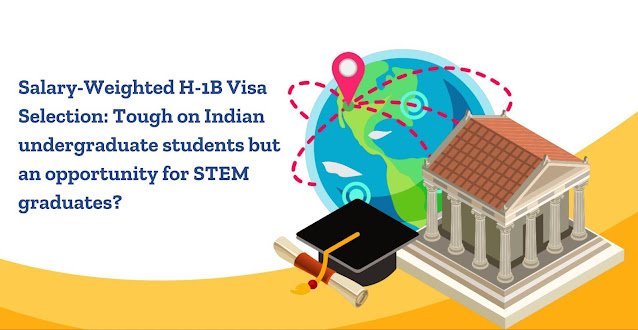
Salary-Weighted H-1B Visa Selection: Tough on Indian undergraduate students but an opportunity for STEM graduates

The
announced changes shift the H-1B selection process toward wage and role-based
outcomes, with neutral to positive impact on Indian Master’s graduates
Bengaluru,
March 12, 2026 : MPOWER Financing, a leading global firm
enabling high-potential international students to pursue higher education
abroad, has shared its assessment of the newly announced changes to the U.S.
H-1B visa program. MPOWER’s internal modeling, based on the past several years
of H-1B results, suggests that the shift from a random lottery to a wage-based
selection would have a neutral or even positive impact for Indian Master’s STEM
graduates.
What
is the new policy?
Today,
the H-1B program operates under an annual cap of 85,000 visas—65,000 in the
general pool and an additional 20,000 reserved for applicants with a U.S.
master’s degree or higher—with demand far exceeding supply. As a result,
selection is currently determined through a random lottery. In parallel,
certain employers such as universities, hospitals, and nonprofit research organizations
are exempt from the cap entirely, allowing them to sponsor H-1B workers
year-round without participating in the lottery.
The
U.S. Department of Homeland Security (DHS) has replaced the traditional random
H-1B (work visa) lottery with a salary-weighted selection system, prioritising
applicants with higher wages. The change takes effect on February 27, 2026.
Under
the revised framework, H-1B registrations will receive weighted selection
chances based on prevailing wage levels. Higher-paying roles will receive
multiple entries in the selection process, while entry-level roles will receive
fewer, shifting the system from a chance-based lottery to a merit- and
wage-based selection model. As a result, candidates in higher-paying and more
specialised roles receive a greater probability of selection.
How
would Indian students be impacted?
Since
over 80% of Indian students in the U.S. are Master’s degree candidates, they
are most likely to enter the workforce at a higher prevailing wage level,
effectively improving their selection odds compared to undergraduate-level
roles.
By
contrast, undergraduate students—particularly those outside STEM and business
disciplines or from less brand-recognised institutions—may face reduced
selection probabilities under the new framework, unless they secure roles with
higher starting wages.
The
H-1B “win rate” remains a long-term calculation. Most STEM-eligible students
can apply for H-1B selection in each of their three years of Optional Practical
Training (OPT). In addition, U.S. Master’s degree holders benefit from a
separate annual allocation of 20,000 H-1B visas, which is over and above the
regular 65,000 cap.
This
advanced-degree allocation effectively provides Master’s graduates with two
opportunities for selection each year—first within the Master’s-only pool, and
then again in the general H-1B pool—materially improving long-term success
rates compared to undergraduate applicants.
Accordingly,
MPOWER’s internal modeling suggests that the transition to a weighted system
will have a marginal impact on the Indian student population’s long-term
success rates:
Current
System: A Master’s degree holder has a 3-year win
rate of 70% (accounting for three years of OPT and the separate Master’s draw).
●
New Weighted System:
Under the new weighted system, a candidate would have a 3-year success rate of
66%: slightly lower, but broadly similar to their success rates under the
current regime.
●
Promotion Impact:
Crucially, if that candidate is promoted to a higher-paying role by their third
year of OPT, their success rate rises to 73%, exceeding their probability under
today’s system. Similarly, graduates of top MBA or MS programs who secure
higher-paying roles in fields such as investment banking, management
consulting, or big tech may enter the system with an advantage, as their
initial compensation levels are more likely to align with the wage-weighted
selection criteria.
Overall,
the modeling suggests a broadly neutral outcome for Indian Master’s degree
students, with improved probabilities for those who advance into higher-paying
roles over time.
More
broadly, the proposed changes apply only to the capped H-1B program and do not
affect other employment-based visa categories. Pathways such as O-1 visas for
individuals with extraordinary ability, L-1 intracompany transfers, G-visas for
employees of international organizations, and permanent residence options such
as EB-2 NIW remain unchanged. For many international graduates, particularly
those with specialized skills or international organization employment, these
alternative routes continue to provide viable and unaffected options for
working in the United States.
It
is also important to note that certain categories of applicants remain exempt
from the annual H-1B cap altogether. Medical graduates and professionals
employed by non-profit organisations, universities, and non-profit or
university-affiliated hospitals may qualify for uncapped H-1B visas, meaning
they are not subject to the annual numerical limits or the new selection framework.
This provides continued stability for healthcare professionals and researchers
trained in the U.S
“The
new framework places greater emphasis on role quality, wage progression, and
skill specialisation,” said Sasha Ramani, Head of Corporate Strategy and
Government Relations for MPOWER Financing. “For Master’s graduates in
high-demand fields, particularly STEM and analytics-driven roles, long-term
outcomes remain largely stable. Students who secure mid-level jobs in
high-paying fields like investment banking, management consulting, or top Tech
companies, or students who grow into higher-paying positions over the course of
their OPT are likely to increase their odds of securing an H1-B under this new
system.”
This
wage-prioritization change comes on top of the recently announced $100,000 H-1B
visa fee, which does not apply to international students transitioning from an
F-1 student visa (and associated OPT period) to H-1B status from within the
United States. This fee-exemption exemption ensures that U.S.-educated
international graduates, who have already invested significantly in American
higher education and workforce readiness, are not subject to additional
financial barriers at the point of transition.
MPOWER also sees
increasing evidence that the value of a U.S. graduate degree is truly global.
Our data suggests that more students are now pursuing parallel post-graduation
pathways—gaining valuable work experience in the U.S. through OPT, while
simultaneously exploring long-term immigration options in Canada as an
alternative career pathway. This dual-track approach allows graduates to
maximize the return on their U.S. education while maintaining flexibility in an
evolving policy environment.
Overall,
MPOWER views these policy updates as a recalibration of the H-1B system rather
than a structural change. For Indian students pursuing U.S. Master’s degrees in
high-demand fields, the pathway remains viable—particularly for those who focus
on skill development, employer quality, and wage progression over time.
About MPOWER Financing
Co-headquartered
in Washington, D.C. and Bengaluru, India, MPOWER Financing is a mission-driven
fintech company and the leading provider of global education loans. Its
proprietary algorithm analyzes overseas and domestic credit data as well as
future earning potential to serve promising international students. MPOWER
works with over 500 top universities across the U.S. and Canada to provide
financing to students from over 200 countries.
The
MPOWER team consists primarily of former international students and provides
students with personal financial education, immigration guidance, and career
support to prepare them for professional success after graduation.
MPOWER
Financing has been named a Great Place To Work, one of the best fintechs to
work for, and a top tech workplace for diversity. The company is hiring for
various positions worldwide. For more information, visit www.mpowerfinancing.com.

Related Posts
Amethyst Wellness: Where Luxury Ayurveda Meets Scientific Well-Being in Surat & Ahmedabad
Bridging the Tech Divide: How SSGSERV is Redefining White-Label IT and Global Tech Support