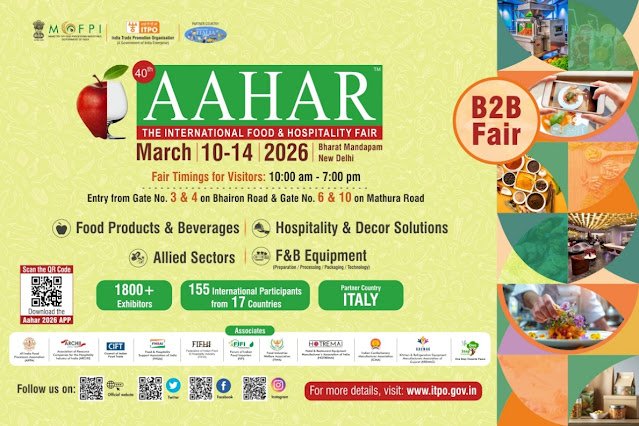
AAHAR 2026 – 40th Edition: Strengthening India’s role in the global food economy through a structured B2B platform

New Delhi | 10th March 2026: At a time when the world is navigating
geopolitical uncertainty, supply chain disruptions, and economic realignments,
food security and food trade have become more critical than ever. In such a
global environment, platforms that strengthen trade partnerships and supply
chain resilience become extremely important. The 40th edition of AAHAR is
therefore not just another exhibition — it is a statement of India’s growing
role in the global food economy.
Over the last
four decades, AAHAR has evolved into one of Asia’s most respected
Business-to-Business platforms for the food and hospitality sector. It connects
producers, processors, exporters, technology providers, hospitality leaders and
institutional buyers from across the world. As India hosts the 40th edition
this year, the exhibition reflects both continuity and transformation —
continuity of a trusted trade platform, and transformation in how the global
food ecosystem is evolving.
AAHAR exists
because trade platforms are essential for translating production strength into
economic opportunity. India today is among the largest producers globally of
milk, spices, rice, fruits and vegetables, and pulses. Specifically, India
accounts for 24% of global milk production, commands a 25% share of the $20
billion global spices market, contributes 28% of world rice production, and
leads in fruits like bananas (26% global production), mangoes (43%), and
papayas (37%). However, production scale does not automatically translate into
proportionate export dominance. These figures illustrate that production alone
does not create economic value. Value is created when agriculture connects with
processing, technology, packaging, logistics and global markets. AAHAR provides
exactly this platform.
Recent export
performance underscores this opportunity. In FY25, dairy exports reached
113,350 metric tonnes valued at $493 million, representing an 80% year-on-year
increase. Similarly, while India produces spices at scale, it captures
approximately 25% of global spice exports, exporting 1.5 million tonnes worth
$4.5 billion annually. Rice exports demonstrate stronger global penetration, with
India shipping 21.55 million tonnes in 2025, valued at approximately $12.95
billion in FY25, representing significant volume in global rice trade. Fruits
and vegetables exports reached $1.82 billion in FY25, while pulses exports hit
a record 876,000 metric tonnes from January to November 2025, with full-year
projections approaching 1 million metric tonnes. These indicators underline a
clear pathway: strengthen value addition and processing capability, promote
technology adoption, and build structured market linkages that expand India’s
presence in global food trade.
AAHAR enables
this through outcomes that are clearly business-focused. It facilitates
business matchmaking, export partnerships, technology exchange and investment
opportunities. For entrepreneurs, processors, hospitality players and
exporters, AAHAR is where real business conversations happen.
Food and hospitality is among the fastest growing sectors in India,
driven by demography, rising prosperity, urbanisation, lifestyle changes,
rapidly growing leisure travel, outsourcing events and the evolution of a
modern market, services and supply chain infrastructure. At the heart of this
growth is the food processing industry. In this context, AAHAR’s relevance
extends across the complete sector—from the front end to the back end—bringing
together stakeholders across food processing and hospitality solutions, and
connecting them to the world.
The scale of this
year’s edition demonstrates the confidence that global industry has in the
platform. AAHAR 2026 features 1800+ exhibitors, including 155 international
exhibitors from 17 countries, with Italy as the Partner Nation. Participants
represent the entire food ecosystem including processed foods, dairy and marine
products, spices and organic produce, bakery and confectionery, food processing
machinery, cold chain technology, packaging innovations and hospitality
solutions. This breadth makes AAHAR one of the most comprehensive food and
hospitality trade events in the region.
The exhibition
increasingly serves as a platform not just for physical products, but for
technology solutions that enhance efficiency and sustainability across the food
value chain. As global supply chains diversify, countries are looking for
stable and reliable sourcing partners. India offers a unique combination of
agricultural scale, skilled workforce, expanding food processing capacity, and
a strong entrepreneurial ecosystem. Total agricultural and processed food
exports reached approximately $49 billion in FY25, with agricultural exports
constituting 11.9–13% of India’s total export basket. The food processing
sector contributes 7.93–8.8% to India’s manufacturing Gross Value Added (GVA)
and accounts for 12.91% of organized employment in the manufacturing sector.
The role of platforms like AAHAR is to accelerate these global linkages and
help Indian businesses connect with international buyers and partners.
A defining pillar
of the platform is its relevance for Micro, Small and Medium Enterprises
(MSMEs) and emerging entrepreneurs. AAHAR has always provided an inclusive
platform for these businesses. Through dedicated startup pavilions,
buyer-seller interaction sessions, and global networking opportunities, the
exhibition enables smaller enterprises to connect with larger markets and institutional
buyers. For many MSMEs, AAHAR is where their products first reach global
buyers, where they secure their first export orders, and where they establish
relationships with technology providers and logistics partners that enable
scale. The government’s support through schemes like PM Formalization of Micro
Food Processing Enterprises (PMFME), Production Linked Incentive (PLI) for food
processing, and infrastructure development under the Pradhan Mantri Kisan
Sampada Yojana (PMKSY) creates an enabling environment that platforms like
AAHAR help translate into commercial opportunities.
The global food
industry is increasingly focused on sustainability and responsible business
practices. This includes responsible sourcing and ethical supply chains, efficient
resource use particularly water and energy, sustainable packaging solutions
reducing plastic use, lower carbon footprints through optimized logistics,
waste reduction and circular economy principles, and organic and regenerative
agriculture practices. Many exhibitors at AAHAR are showcasing innovations in
these areas, reflecting the industry’s commitment to responsible growth.
Sustainability is no longer a peripheral concern but a core competitive
advantage in global food trade.
Chairman, ITPO Quote:
The food and
hospitality sector is among the fastest-growing sectors in India, driven by
favourable demographics, rising prosperity, urbanisation, changing lifestyles,
growing leisure and business travel, outsourcing of events, and the evolution
of modern markets, services, and supply chain infrastructure.
At the core of this
ecosystem lies the food processing industry.
India is already a
major exporter of agricultural products. Exports of value-added products,
equipment, and accessories are emerging as a new priority and are showing
promising growth. Our new Free Trade Agreements will further expand export
opportunities, which are vital for our farmers and the MSME sector.
AAHAR brings together
all segments of this industry — from the front end to the back end — and
connects them with the global market. International participation continues to
grow, and for the first time, Italy is the Partner Country for this edition.